
Of all the cross-border retirement questions, “can I just move my 401(k) into my RRSP?” has the most seductive answer — yes, technically — and the most misunderstood price tag. There is a real provision in Canadian tax law that lets you do it without using any RRSP contribution room. But for most people under age 59½, using it is a quiet, expensive mistake. This post is the rulebook: how the transfer actually works, the three costs it can’t escape, the conditions that disqualify more people than expect it, and the narrow cases where it’s worth doing. For how this fits with leaving the account in the US, see the full guide to US retirement accounts in Canada.
First, the honest answer: usually, don’t
There is no button that moves a 401(k) directly into an RRSP. What exists is an indirect transfer: you pull the money out of the US plan (a taxable event in the US), then re-contribute it to your RRSP and claim a special offsetting deduction. On the Canadian side that nets to roughly zero tax. The problem is everything that happens on the US side on the way through — and for anyone under 59½, that’s usually enough to make leaving the account in the US the better call.
The confusion is understandable, because the language sounds familiar. Inside the US, moving a 401(k) to an IRA is a genuine rollover: the money never touches your hands, nothing is taxed, nothing is withheld, and the deferral continues uninterrupted. Canadians hear “rollover” and reasonably assume the cross-border version works the same way. It does not. There is no treaty provision, no custodian form, and no CRA election that turns a 401(k) into an RRSP tax-free. What paragraph 60(j) offers is damage control on the Canadian side of a transaction that is fully taxable on the US side.
How a 401(k)-to-RRSP transfer actually works
The mechanism is paragraph 60(j)(i) of the Income Tax Act.
The four steps
- You take a lump-sum withdrawal from the 401(k) (it must be a lump sum, not a series of periodic payments).
- You include the full amount in your Canadian income for the year.
- You contribute an equal amount to your RRSP — in the year of the withdrawal or within 60 days after year-end.
- You claim an offsetting deduction under paragraph 60(j), designated as a transfer on Schedule 7 of your T1.
Step 4 is where returns go wrong. The contribution has to be designated as a transfer, not reported as an ordinary RRSP contribution. Report it in the wrong place and you have simultaneously used up contribution room you didn’t need to use, failed to claim the deduction that makes the whole thing work, and left the full withdrawal sitting in your income as taxable. That is a fully avoidable and genuinely expensive filing error, and it is the single most common one on these transfers.
Why it doesn’t touch your RRSP contribution room
Here is the elegant part: the 60(j) deduction does not use your regular RRSP contribution room. It is over and above your normal limit, capped at the lesser of the amount contributed and the amount included in income. So a $100,000 transfer does not consume $100,000 of room, and it does not create an overcontribution penalty even if you have no room at all. On the Canadian side, the income in and the deduction out cancel, and the transfer is tax-neutral.
This is the feature that makes people want to do it. It is real, and it is genuinely useful — for the small number of people who clear every other hurdle.
The conditions that are easy to miss
Three conditions attach, and each one disqualifies more people than expect it:
- The plan must relate to services you performed while a non-resident of Canada. This is the one that catches people. If you built that 401(k) while commuting to a US employer from a Canadian home, or during a stretch where you remained a Canadian tax resident, that portion may not qualify. Cross-border commuters and anyone who kept Canadian residency during a US assignment need this checked against their actual work and residency history before assuming eligibility.
- You must be a Canadian resident when you make the RRSP contribution. The withdrawal and the contribution sit on opposite sides of your move, so the sequencing matters.
- It must happen by December 31 of the year you turn 71 — the same deadline that closes your RRSP and converts it to a RRIF.
 alt=”” width=”1200″ height=”720″ />
The three costs the transfer can’t escape
The Canadian side is clean. The US side is where the money leaks.
1. US income tax on the withdrawal
Pulling money out of a 401(k) is a taxable distribution in the US. The treaty doesn’t make it disappear; it just coordinates who taxes what. The US taxes the withdrawal as pension and annuity income, and the custodian withholds.
Worth knowing: the treaty’s reduced 15% withholding rate applies to periodic pension payments. A lump sum is not periodic, so it does not get that cap — which is precisely why the withholding on these transfers lands so much higher than people expect.
2. The 10% early-withdrawal penalty — if you’re under 59½
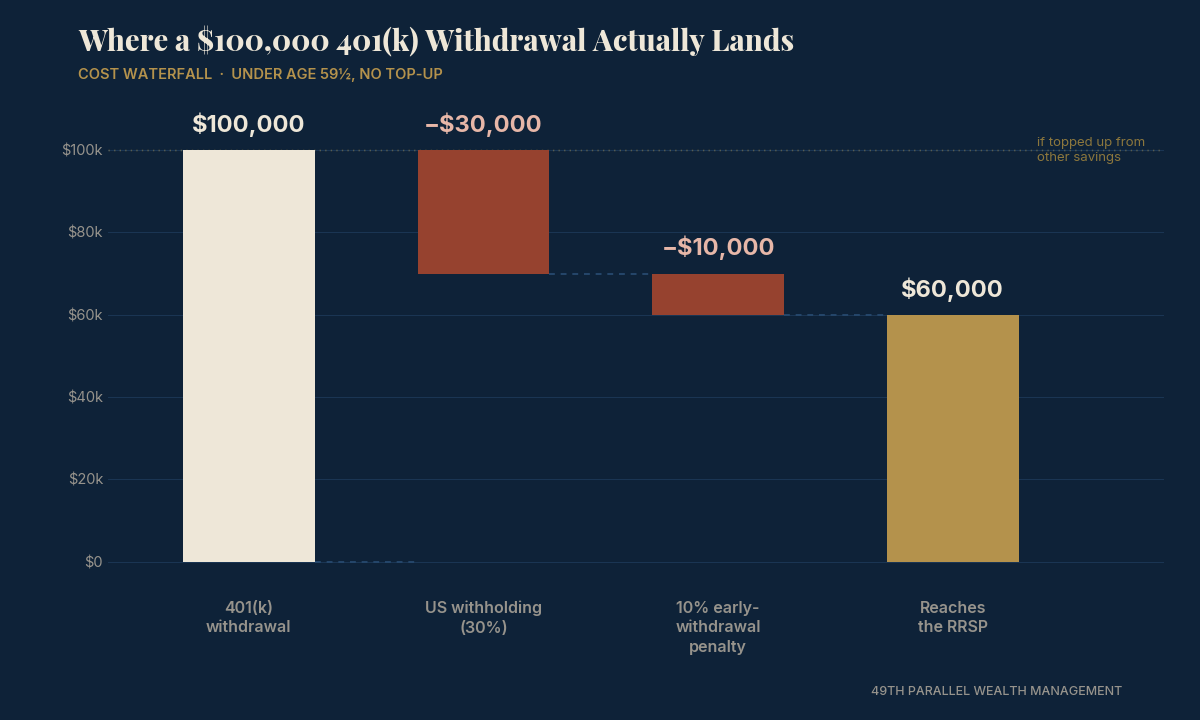
This is the deal-breaker. On top of regular US tax, an early withdrawal triggers the IRS additional 10% tax on early distributions. That penalty has no Canadian equivalent to credit it against, so it’s a pure, unrecoverable cost — often the single line that sinks the whole idea.
Note the asymmetry: it is a penalty, not a tax, for foreign tax credit purposes. Canada gives you credit for foreign income tax paid. It does not give you credit for a US penalty. There is no mechanism, no election, and no treaty article that recovers it. The money is simply gone.
3. The stranded foreign tax credit
Here’s the subtle one, and the one that surprises even people who budgeted for the first two. The US tax you pay is normally recoverable in Canada as a foreign tax credit (Form T2209). But the 60(j) deduction has just reduced your Canadian tax on that transferred amount to roughly zero — which means there’s little or no Canadian tax for the US credit to offset. Without other foreign-source income to absorb it, the foreign tax credit can be largely wasted. You paid the US tax, and you don’t get it back.
There is a real tension here that is worth stating plainly: the 60(j) deduction and the foreign tax credit work against each other. The better the deduction protects you from Canadian tax, the less Canadian tax remains for the US credit to offset, and the more of that US tax becomes a permanent cost. You cannot fully benefit from both at once. Recognising that trade-off is most of what separates a modelled decision from a hopeful one.
The withholding-and-top-up trap
To make the rollover work fully, you have to contribute the gross amount to the RRSP — but the custodian only sends you the net after withholding. US withholding on a lump sum to a non-resident is often 30% (and a 401(k) eligible-rollover distribution can carry 20% mandatory federal withholding). On a US$100,000 withdrawal, that’s US$20,000–$30,000 you never see.
If you want to deduct the full $100,000, you must top up the withheld amount out of other savings so the RRSP receives the whole $100,000. If you can only contribute the net, you can only deduct the net — and the difference stays in your Canadian income as a taxable shortfall. Filing Form W-8BEN with the custodian to claim treaty benefits can reduce withholding on eligible payments, but it doesn’t remove the underlying US tax or the penalty.
Run the shortfall math on a $100,000 withdrawal with 30% withheld and no top-up. You contribute $70,000 and deduct $70,000. The remaining $30,000 stays in your Canadian income and is taxed at your Canadian marginal rate — call it 45% in a mid-bracket, so roughly $13,500 of Canadian tax. Add the $10,000 penalty if you are under 59½. You have now paid tax twice on overlapping money and moved $70,000 across the border at a cost that can approach a third of the account. The top-up isn’t a nice-to-have; without liquid savings sitting outside the plan, the transfer doesn’t really work.
Does your citizenship change the math?
Yes, more than most articles admit. A US citizen or green card holder living in Canada is still taxed by the US on worldwide income, files a 1040 every year, and faces graduated US rates on the withdrawal rather than flat non-resident withholding. A Canadian citizen with no US status is a non-resident alien to the IRS and is generally subject to flat statutory withholding on the distribution.
Those two people can run the identical transfer and end up with materially different outcomes, because the rate applied, the return filed, and the credits available all differ. If you hold US citizenship or a green card, do not use non-resident withholding figures as your planning assumption — and vice versa. This is one of the places where generic online guidance most reliably misleads.
What about state tax?
Generally, once you are no longer a resident of the state, federal law restricts states from taxing retirement plan distributions from a former resident. That is helpful, but it is not universal in its application, and states differ in how they treat the year of departure and how aggressively they contest a claimed change of residency. If you left a high-tax state recently, treat state exposure as a live question rather than a settled one.
The FX cost nobody budgets for
Your 401(k) is denominated in US dollars. Your RRSP contribution will be measured in Canadian dollars. A transfer therefore forces a one-time, irreversible conversion of a large balance at whatever rate happens to prevail that week.
That is a real risk that sits outside the tax analysis entirely. It also quietly changes your portfolio: leaving the account in the US keeps a US-dollar asset matched against any future US-dollar spending, while converting locks you into Canadian dollars permanently. If you expect to spend part of your retirement in the US, own US property, or support family there, that currency match has value you would be giving up. Retail conversion spreads on a six-figure transfer are worth pricing too — they are not trivial, and they are avoidable if you leave the account where it is.
Does an IRA qualify? Does a Roth?
A traditional IRA can generally qualify for the same 60(j)(i) treatment, provided the non-residency-of-Canada condition is met — the rules in our IRA in Canada guide apply. A Roth IRA does not qualify, and you wouldn’t want it to: a Roth is already protected tax-free in Canada through a one-time treaty election, so there’s nothing to gain and the protection to lose. If you hold Roth money, read your Roth IRA after moving to Canada before doing anything.
Transferring a Roth would be close to a worst-case move: you would trigger US tax and possibly a penalty on money that was already positioned to grow tax-free for life on both sides of the border, and you would convert a tax-free asset into ordinary RRSP money that is fully taxable on withdrawal. If you take one thing from this article, let it be that Roth accounts do not belong anywhere near this conversation.
Other plan types — 403(b), 457, SEP and SIMPLE IRAs, and employer pensions — each have their own characterisation under both the Act and the treaty, and eligibility does not follow automatically from the 401(k) answer. Have the specific plan type confirmed rather than assumed.
What you give up by transferring
Even where the transfer is technically available and the tax cost is tolerable, you are trading away things that don’t show up in a tax calculation:
- Continued deferral. Left alone, the 401(k) compounds untouched. A transfer interrupts that to pay tax today for the privilege of holding the same money in a different wrapper.
- Currency matching against future US-dollar needs, as above.
- Investment options. US plans and IRAs often provide access to low-cost institutional funds. What replaces them inside your RRSP may be more expensive.
- Flexibility in the drawdown years. Holding accounts in both countries gives you two levers to pull when managing your bracket in retirement. Consolidating removes one.
Set against that, the honest case for transferring is administrative: one country, one currency, one set of statements, no annual foreign reporting, and nothing for an executor to untangle in a second jurisdiction. That is a genuine benefit. It is simply rarely worth five figures.
A worked example: the same transfer, two ages
Take a $200,000 401(k) and a Canadian resident with a 45% marginal rate.
Age 52. The withdrawal triggers US tax, plus a $20,000 early-withdrawal penalty that Canada will never credit. Withholding of 30% means $60,000 is retained at source, so the full transfer requires finding $60,000 from other savings to keep the RRSP contribution whole. The 60(j) deduction then wipes out the Canadian tax on the $200,000 — which means most of the US tax paid has no Canadian tax left to offset, and much of the foreign tax credit is stranded. The account arrives in Canada, but a substantial slice of it has been converted into permanent, unrecoverable cost. Leaving it in the US would have cost nothing at all this year.
Age 63, with US rental income. No penalty applies. The rental income is foreign-source, so there is other Canadian tax for the foreign tax credit to offset, and the credit is far less likely to strand. Liquid savings are available for the top-up. This person is also permanently settled in Canada with no expectation of US-dollar spending, so the FX conversion is not a real loss. Here the transfer can be defensible — not because the tax is free, but because the leakage is small enough that consolidation is worth paying for.
Same provision, same account, opposite conclusions. The variables that flipped it were age, the presence of other foreign-source income, and liquidity — not the size of the balance.
When the transfer actually makes sense
It isn’t never. The narrow cases:
- You’re 59½ or older, so there’s no 10% penalty, and you have other foreign-source income so the foreign tax credit isn’t stranded.
- You’re permanently severing US ties and value having everything consolidated in Canada over the tax leakage.
- The balance is small enough that simplicity outweighs the cost.
- Your US marginal rate on the withdrawal happens to be low (e.g., a low-income year).
Notice that these tend to arrive together rather than alone. One of them on its own rarely carries the decision; it is the combination of no penalty, absorbable foreign tax credit, and available liquidity that makes the arithmetic work. Outside those, the math usually favours leaving the account where it is.
The usual better answer: leave it in the US
For most people, the cleanest path is to do nothing — leave the 401(k) in the US, where Article XVIII of the Canada-U.S. Tax Convention keeps it deferring tax exactly as it did before you moved. It grows untouched, and you’re taxed only on withdrawal, with the foreign tax credit doing its job. The full case for leaving it (and the custodian wrinkles to watch) is in what happens to your 401(k) when you move to Canada. When you do start drawing it down, the order you tap your accounts matters — we cover that in which account to spend first.
“Do nothing” is not the same as “ignore it.” Leaving the account in place still means confirming your custodian will maintain an account for a Canadian-resident holder, keeping your address and withholding paperwork current, and meeting Canadian foreign reporting obligations. The account is passive; your administration of it shouldn’t be.
Transfer or leave it: side by side
| Transfer to RRSP | Leave in the US | |
| Tax this year | US tax due; Canadian side roughly neutral | None |
| Penalty under 59½ | 10%, unrecoverable | None |
| Deferral | Interrupted | Continues under the treaty |
| RRSP room used | None — deduction is over and above | Not applicable |
| Cash needed up front | Yes, to top up withholding | None |
| Currency | Locked into CAD | Stays in USD |
| Admin going forward | Simplified to one country | Two countries, ongoing reporting |
| Reversible? | No | Yes — you can still transfer later |
That last row deserves weight. Leaving the account in the US preserves the option to transfer in a future year when you are past 59½, in a lower-income year, or holding other foreign-source income. Transferring forecloses everything. When one path is reversible and the other isn’t, the burden of proof belongs on the irreversible one.
If you do go ahead: a sequencing checklist
- Confirm the plan relates to services performed while you were a non-resident of Canada.
- Confirm you are a Canadian resident at the time you will make the RRSP contribution.
- Model the whole thing first: US tax, penalty if applicable, expected withholding, the recoverable portion of the foreign tax credit, and the deferral you’re giving up.
- Have the top-up cash identified and liquid before initiating anything.
- File Form W-8BEN with the custodian ahead of the distribution, where applicable — after the fact is too late.
- Request the distribution as a lump sum, and confirm in writing that the plan is coding it that way.
- Make the RRSP contribution within the window: same calendar year, or within 60 days of year-end.
- Designate the contribution as a transfer on Schedule 7 — not as an ordinary contribution.
- Keep the US slips, the RRSP contribution receipt, and the conversion rate used, together, for both returns.
Steps 4 and 8 are the ones that most often go wrong in practice, and both are entirely preventable with a week of advance planning.
Five mistakes we see most
- Assuming it’s a rollover. It is a taxable withdrawal followed by a contribution. Nothing about it is tax-free.
- Forgetting the penalty is not creditable. Under 59½, that 10% is a permanent loss, not a timing difference.
- Contributing only the net. Deducting only the net leaves the withheld portion exposed to Canadian tax as well.
- Filing it as an ordinary RRSP contribution. This wastes room and forfeits the deduction that makes the transfer work.
- Moving a Roth. Trading a permanently tax-free asset for a taxable one, and paying tax for the privilege.
Frequently asked questions
Can I transfer my 401(k) to an RRSP?
Yes, but indirectly. There’s no direct rollover; under paragraph 60(j)(i) you take a lump-sum withdrawal, include it in Canadian income, contribute an equal amount to your RRSP, and claim an offsetting deduction. It is not the same as a US-to-US rollover.
Will I pay tax to transfer a 401(k) to an RRSP?
On the Canadian side it’s tax-neutral (income in, deduction out). But the US withdrawal is taxable in the US, and if you’re under 59½ it also triggers a 10% early-withdrawal penalty that Canada will not credit.
Does the transfer use up my RRSP contribution room?
No. The 60(j) deduction is over and above your regular RRSP limit, so it doesn’t consume the room you’d use for normal contributions.
Can I transfer an IRA to an RRSP?
Generally yes, a traditional IRA can qualify under paragraph 60(j)(i) if the conditions are met. A Roth IRA does not qualify — and shouldn’t be transferred, since it’s already protected tax-free in Canada by treaty election.
What are the timing rules?
The RRSP contribution must be made in the year you receive the withdrawal or within 60 days after that year ends, you must be a Canadian resident when you contribute, and the transfer must be completed by December 31 of the year you turn 71.
Why might the foreign tax credit not help me?
Because the 60(j) deduction reduces your Canadian tax on the transferred amount to roughly zero, there may be little or no Canadian tax for the US tax to offset. Without other foreign-source income, that foreign tax credit can be largely wasted.
Should I transfer my 401(k) to an RRSP before age 59½?
Usually not. The 10% early-withdrawal penalty is unrecoverable in Canada, and combined with the potential stranded foreign tax credit, the leakage often outweighs any benefit. Leaving the account in the US is typically better.
Is it better to just leave my 401(k) in the US?
For most people, yes. Under the treaty, the account keeps deferring tax and grows untouched until you withdraw, with a foreign tax credit preventing double taxation. There’s rarely a tax reason to rush a transfer.
Do I need to top up the US tax that was withheld?
If you want to transfer and deduct the full gross amount, yes — you replace the withheld portion from other savings so the RRSP receives the whole amount. Otherwise you can only contribute and deduct the net, leaving the difference as taxable income.
Can I transfer part of my 401(k)?
The provision requires a lump sum, and partial approaches raise questions about whether the distribution still qualifies. Because the characterisation matters and errors here are not fixable after the fact, treat any partial or staged plan as something to confirm in advance rather than assume.
What if I’ve already moved to Canada and taken the withdrawal?
Timing is what matters: the contribution must fall in the year of the withdrawal or within 60 days after year-end, and you must be a Canadian resident when you contribute. If you are still inside that window, there may be time to complete it properly. If the window has closed, the withdrawal generally stays in income without the offsetting deduction — which is worth getting reviewed quickly rather than at filing time.
Does a 401(k)-to-RRSP transfer affect my RRIF at 71?
Once inside your RRSP, transferred funds are ordinary RRSP money and follow the normal rules — including conversion to a RRIF by the end of the year you turn 71 and minimum withdrawals after that. The transfer itself must also be completed by that same deadline.
More from US Retirement Accounts in Canada
This post is part of our cross-border retirement series:
- US Retirement Accounts in Canada: 401(k), IRA & Roth IRA After You Move North — the pillar guide
- What Happens to Your 401(k) When You Move to Canada
- Your Roth IRA After Moving to Canada: Keeping It Tax-Free
If you’re weighing a transfer, model it before you move a dollar. Our cross-border retirement strategy team runs the actual numbers — US tax, penalty, the foreign tax credit, and the deferral you’d give up — side by side.
Thinking about a 401(k)-to-RRSP transfer? Don’t move a dollar before the numbers are run. Book a complimentary consultation and we’ll model the transfer against simply leaving it in the US — before the decision becomes irreversible.
