

A traditional IRA is the quietest of the US retirement accounts to carry across the border, and that is exactly what makes it dangerous. Nothing breaks when you become a Canadian resident. No election is due, no letter has to be filed, no deadline passes. The account simply keeps compounding, which is why people assume it needs no attention at all — and then discover, years later, that the withdrawal tax, the withholding rate, the required distributions, and the custodian’s willingness to hold the account for a non-US resident were all decisions they could have planned around and didn’t. This post covers what actually changes and what genuinely doesn’t. For how the IRA sits alongside your other US accounts, start with the full guide to US retirement accounts in Canada.
The short version
Your traditional IRA keeps deferring tax after you move to Canada. You are taxed when you withdraw, in both countries, with a foreign tax credit stopping the double-up. Required minimum distributions still apply on the US timetable regardless of where you live. You generally cannot contribute any more. And moving the account into an RRSP is possible but usually a bad idea.
Almost everything else in this article is detail hanging off those five sentences.
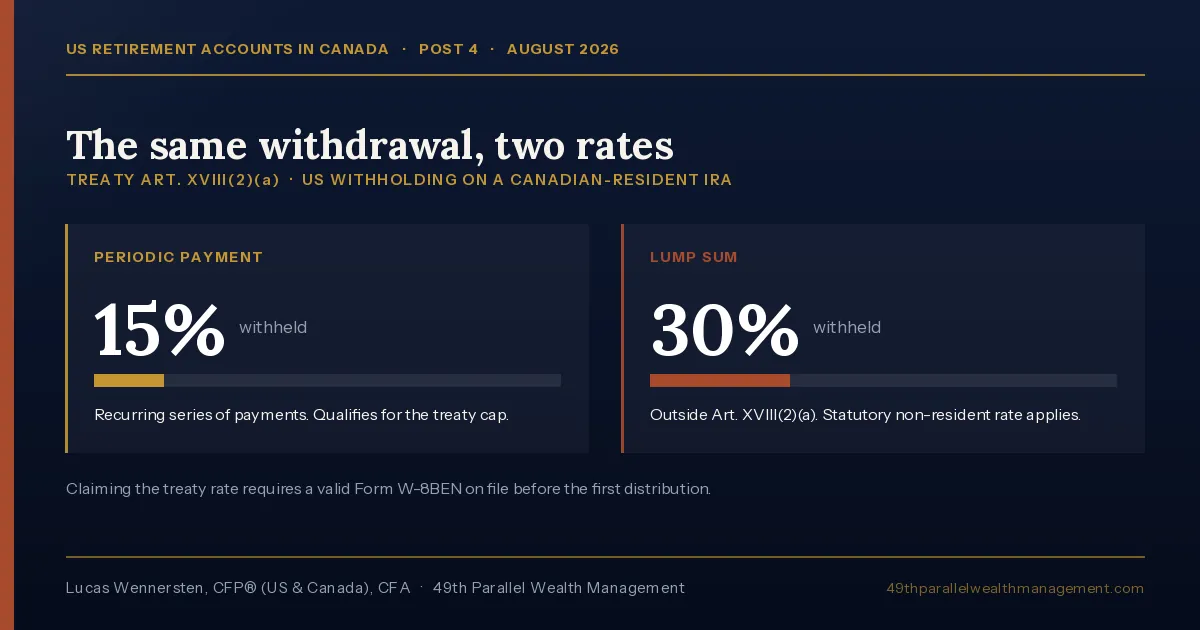 alt=”Periodic vs lump-sum IRA withdrawal in Canada: 15% treaty withholding against the 30% statutory rate” width=”1200″ height=”630″ />
| How the same IRA withdrawal is withheld at different rates depending on whether it is structured as a periodic payment or a lump sum. |
Does the treaty protect the deferral?
Yes — and this is the part that works in your favour without any action on your part. Under the Canada-United States Tax Convention, growth inside a recognised US retirement plan is not taxed by Canada as it accrues. Interest, dividends, and capital gains earned inside the IRA stay untaxed on both sides until money comes out.
That is a meaningful protection, and it is worth understanding why it matters. Without it, the CRA would treat the account as an ordinary foreign investment portfolio and tax the internal earnings every year, whether or not you touched them — which is precisely the trap that catches Roth IRA holders who fail to file their one-time election. The traditional IRA does not carry that risk in the same way, because deferral is the default treatment rather than something you elect into.
Two cautions, though. First, “no action required” is not the same as “no attention required” — the reporting, withholding, and distribution mechanics below all still need managing. Second, the protection covers the account as a retirement plan; it does not extend to whatever you do with the money after it leaves the account.
How withdrawals are taxed once you’re a Canadian resident
The Canadian side
Once you are a Canadian tax resident, an IRA withdrawal is included in your Canadian income as foreign pension income and taxed at your ordinary marginal rate. There is no Canadian equivalent of the US pension-income splitting rules for every account type, and no preferential rate — this is fully taxable income in the year received.
The practical consequence is bracket management. A large withdrawal in a single year can push you into a materially higher Canadian bracket, and unlike a Canadian RRIF there is no minimum-only default that keeps the amounts small by design. If you have discretion over timing, you have a planning lever.
The US side and the 15% question
The US also taxes the distribution, and the custodian withholds. Which rate applies is where structure earns its keep. The treaty reduces withholding on periodic pension payments to 15%; a lump sum does not qualify for that reduced rate and is exposed to the higher statutory rate. Structuring a drawdown as a recurring periodic payment rather than an ad-hoc lump sum can therefore change the withholding materially on identical economics.
To claim the treaty rate at all, the custodian needs a valid Form W-8BEN on file, with a Canadian address and a taxpayer identification number. File it before the first distribution, not after — recovering over-withheld tax means filing a US return and waiting, rather than simply having had the right rate applied. The mechanics of taxable distributions are set out in IRS Publication 590-B.
If you are a US citizen or green card holder living in Canada, none of the non-resident withholding framework applies to you in the same way — you remain a US taxpayer on worldwide income, file a 1040, and face graduated US rates. Do not plan off non-resident figures if that describes you.
The foreign tax credit
Both countries taxing the same withdrawal does not mean you pay twice. Canada gives you a foreign tax credit for the US tax paid, claimed on Form T2209, which offsets the Canadian tax on that same income.
Where this gets uncomfortable is when the credit exceeds the Canadian tax available to offset. Because the credit is limited to the Canadian tax on that foreign income, an unusually high US tax figure — or a year with little other Canadian income — can leave part of the US tax unrecovered. This is the same stranding problem that makes RRSP transfers expensive, and it is worth modelling rather than assuming the credit is automatically a wash.
Required minimum distributions don’t stop at the border
This is the obligation people most often miss. Traditional IRAs are subject to required minimum distributions, and moving to Canada changes nothing about them. The IRS timetable follows the account, not your address.
Under current rules, RMDs begin at age 73 for individuals reaching age 72 after December 31, 2022, with the starting age scheduled to rise to 75 in 2033 (2025 rules — verify the current figure, as this is legislated to change). The penalty for missing one is real, and the calculation depends on your prior-year balance and life expectancy factor.
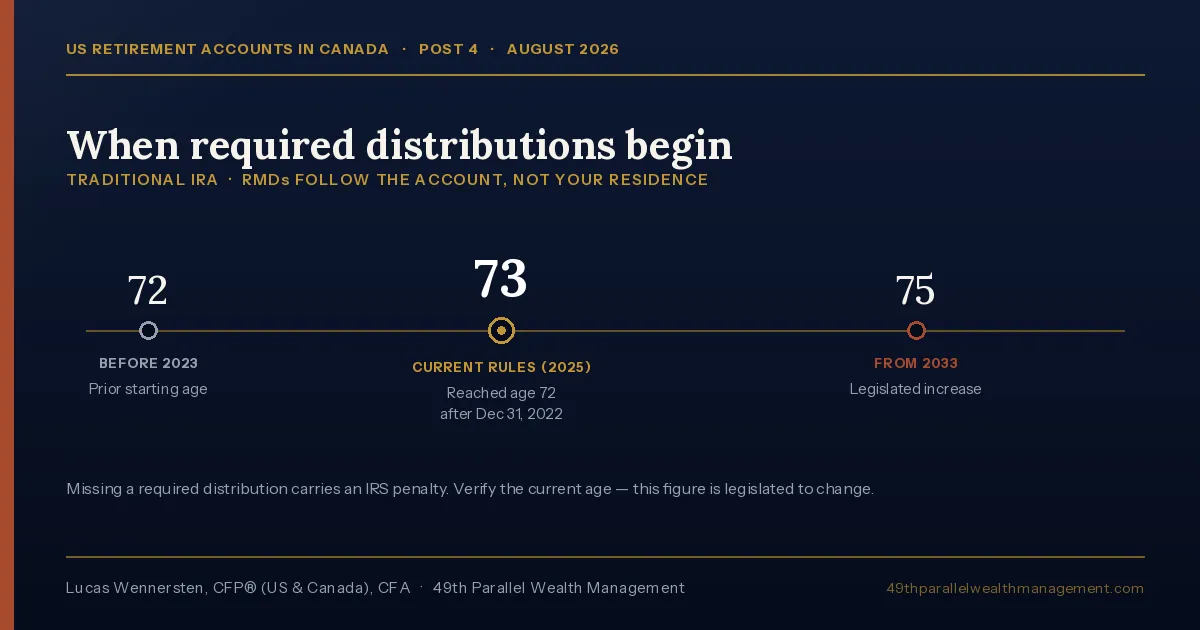 alt=”Timeline of IRA required minimum distribution starting ages, showing age 73 under current rules rising to 75 in 2033. ” width=”1200″ height=”630″ />
| Required minimum distribution starting ages for traditional IRAs under current legislation, including the scheduled increase to age 75. |
Two cross-border wrinkles are worth flagging. Your RMD is a taxable Canadian receipt in the year you take it, so it interacts with your Canadian bracket and any Canadian minimum withdrawals you are already taking from a RRIF. And because the RMD is compulsory, it removes the timing discretion that would otherwise be your main planning lever — which is an argument for shaping the account’s drawdown before RMDs begin rather than after.
Can you still contribute to an IRA as a Canadian resident?
Generally, no. Contributing to a traditional IRA requires eligible compensation — earned income — and the relevant income has to be taxable in the US. A Canadian resident with only Canadian employment income typically has no basis for a contribution.
The narrow exceptions involve people who continue to earn US-source employment or self-employment income after the move, such as cross-border commuters. Even then the interaction with Canadian residency and the treaty needs checking rather than assuming. For most people the practical answer is that the IRA becomes a closed, compounding account: you manage it, you eventually draw it, but you no longer add to it.
The custodian problem
This is an administrative issue rather than a tax one, and it derails more plans than the tax rules do. Many US brokerages will not maintain a retirement account for a Canadian-resident holder, or will maintain it but restrict what you can do inside it — often freezing new purchases while allowing sales and withdrawals only.
The result is an account you technically still own but cannot manage: you can’t rebalance, can’t reinvest a maturing position, and may be pushed toward liquidating on the custodian’s timetable rather than yours. Before you assume the do-nothing path is available, confirm in writing that your custodian will hold the account for a Canadian resident and what activity remains permitted. Some firms with cross-border registration will; many retail platforms will not. Finding out early is the difference between choosing a strategy and having one imposed.
Does an IRA go on a T1135?
Canadian residents holding more than CA$100,000 in specified foreign property must file CRA Form T1135 – Foreign Income Verification. The natural assumption is that a US IRA counts. In fact, foreign retirement arrangements are generally excluded from the definition of specified foreign property, which is why an IRA typically does not need to be reported there.
Treat that as a proposition to confirm rather than a rule to rely on. The exclusion turns on how the specific account is characterised, the treatment is not identical across every type of US retirement plan, and the penalties for getting a T1135 wrong are steep enough that this is worth a direct answer from your own preparer about your own account.
Should you move it into an RRSP?
You can, and usually you shouldn’t. Paragraph 60(j)(i) of the Income Tax Act permits an indirect transfer — a lump-sum withdrawal, included in Canadian income, offset by a special deduction that doesn’t consume your RRSP room. On the Canadian side it nets to roughly nothing.
The problem is entirely on the US side: the withdrawal is fully taxable there, an early-withdrawal penalty applies below age 59½ and is not creditable in Canada, and the offsetting deduction can leave the foreign tax credit stranded. We work through the full arithmetic, including a worked example at two different ages, in transferring a 401(k) or IRA to an RRSP. Read that before you initiate anything, because the transaction is not reversible.
Traditional versus Roth — don’t apply this article to a Roth
Everything above concerns traditional IRAs. A Roth IRA is a different instrument with a different Canadian treatment, and the single most consequential difference is that the Roth requires a one-time treaty election, filed by the due date of your first Canadian return, to preserve its tax-free status. Miss it and the CRA can tax the internal growth annually — the exact outcome the traditional IRA’s default deferral spares you.
If you hold both, they need separate handling. The Roth rules, the election letter, and the contribution trap that permanently splits the account are covered in your Roth IRA after moving to Canada.
Inherited IRAs are a different problem
An IRA you inherit as a Canadian resident does not follow the rules above. Beneficiary distribution requirements, the treatment of the account under the treaty, and the Canadian characterisation of the receipts all differ from those for an account you own outright, and the compressed distribution windows that apply to many non-spouse beneficiaries can force taxable income into a short period whether it suits your bracket or not.
If an inherited IRA is in the picture, treat it as its own planning exercise rather than an extension of this one — the intersection of US beneficiary rules and Canadian residency is one of the least forgiving corners of cross-border retirement work.
US estate tax exposure
A traditional IRA held by someone who is not a US citizen or domiciliary raises a separate question from income tax: whether the account is exposed to US estate tax at death, and what the treaty does about it. The Canada-US treaty provides relief for Canadian residents that the general non-resident rules do not, but the analysis depends on your citizenship, domicile, the size of your worldwide estate, and what else you hold with US situs.
The point here is not to resolve it in a paragraph but to flag that an IRA is an estate-planning asset as well as a retirement asset, and that the two analyses need to be run together rather than sequentially.
Which account should you spend first?
Holding a traditional IRA alongside an RRSP, a TFSA, and taxable accounts creates a sequencing question with real money attached. The IRA’s compulsory RMDs, the availability of the 15% treaty withholding on periodic payments, and your Canadian bracket in any given year all pull in different directions.
There is no universal answer, but there is a right way to work it out, and we set out the framework in which account to spend first. If you would rather have the numbers run against your actual holdings, that is what our cross-border retirement planning work is for.
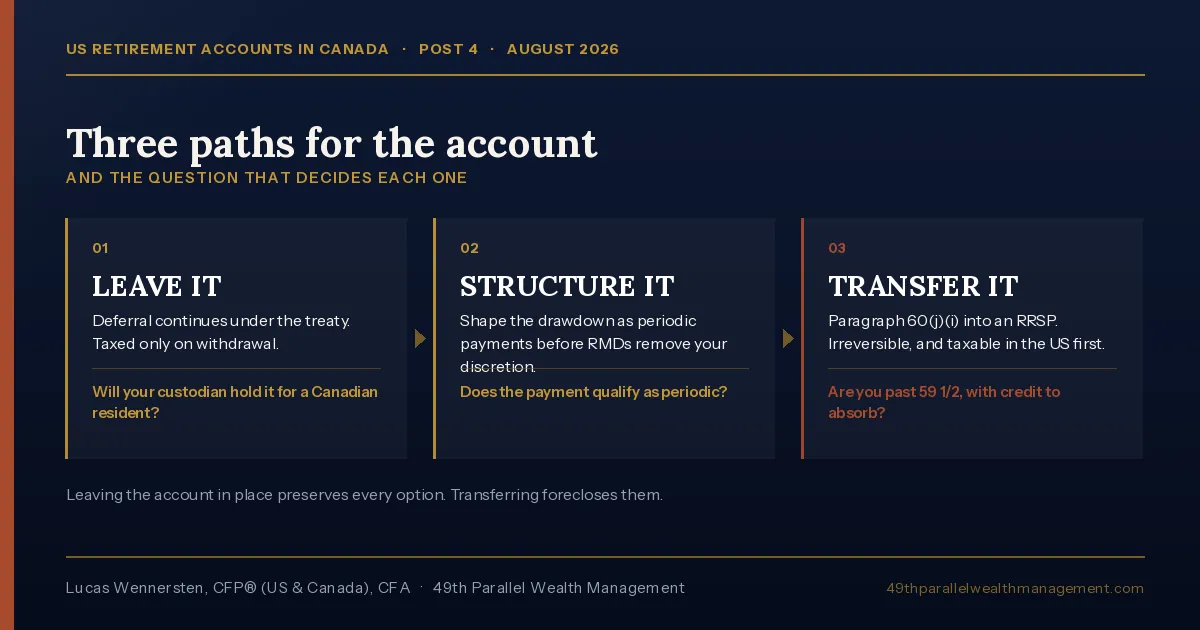 alt=”Decision paths for a traditional IRA in Canada: draw down, structure periodic payments, or transfer to an RRSP” width=”1200″ height=”630″ />
| The three paths available for a traditional IRA after a move to Canada, and the questions that determine which one applies. |
Frequently asked questions
What happens to my IRA when I move to Canada?
Nothing automatically. The treaty preserves the tax deferral, so the account keeps growing untaxed by either country until you withdraw. You do not need to file an election to protect a traditional IRA, unlike a Roth IRA.
Is my IRA taxable in Canada?
The growth inside it is not taxed as it accrues. Withdrawals are taxable in Canada as foreign pension income at your ordinary marginal rate, with a foreign tax credit for the US tax paid on the same money.
How much US tax is withheld on an IRA withdrawal?
It depends on how the withdrawal is structured. The treaty reduces withholding on periodic pension payments to 15%, while a lump sum does not qualify for that reduced rate. You need a valid Form W-8BEN on file with the custodian to claim the treaty rate at all.
Do I still have to take required minimum distributions in Canada?
Yes. RMDs follow the account, not your residence. Traditional IRAs are subject to the US distribution timetable regardless of where you live, and missing one carries a penalty.
Can I contribute to my IRA as a Canadian resident?
Generally no. Contributions require eligible US earned income, which most Canadian residents no longer have. Cross-border workers with continuing US employment income are the narrow exception and should have it confirmed.
Can I transfer my IRA to an RRSP?
A traditional IRA can generally qualify for an indirect transfer under paragraph 60(j)(i), but it is a taxable withdrawal in the US first. The early-withdrawal penalty below age 59½ is not creditable in Canada, so for most people the cost outweighs the benefit.
Does my IRA need to be reported on a T1135?
Foreign retirement arrangements are generally excluded from specified foreign property, so an IRA typically does not go on the T1135. Because the exclusion depends on how the account is characterised and the penalties are significant, confirm the treatment for your specific account.
Will my US brokerage let me keep the account?
Not always. Many US custodians restrict or refuse to maintain retirement accounts for Canadian-resident holders, sometimes allowing withdrawals but blocking new purchases. Confirm in writing what your custodian permits before you build a plan around leaving the account in place.
Is a traditional IRA treated the same as a Roth IRA in Canada?
No. A traditional IRA defers tax by default, while a Roth IRA requires a one-time treaty election to keep its growth tax-free in Canada. Missing the Roth election can make the account’s internal growth taxable in Canada every year.
Should I withdraw from my IRA before or after moving to Canada?
It depends on your marginal rate in each country, your age relative to 59½, and whether the withdrawal can be structured as a periodic payment. Because the answer turns on figures specific to you, this is worth modelling before the move rather than after.
More from US Retirement Accounts in Canada
This post is part of our cross-border retirement series:
| US Retirement Accounts in Canada: 401(k), IRA & Roth IRA After You Move North — the pillar guide |
| What Happens to Your 401(k) When You Move to Canada — the custodian and deferral rules for employer plans |
| Your Roth IRA After Moving to Canada: Keeping It Tax-Free — the one-time treaty election and the contribution trap |
| Transferring a 401(k) or IRA to an RRSP: The Cross-Border Rules — paragraph 60(j), the 10% penalty, and when it makes sense |
Holding a US IRA as a Canadian resident? The default is deferral — but the withdrawal rate, the RMD timetable, and your custodian’s rules are all decisions worth making deliberately. Book a complimentary consultation and we’ll model your drawdown across both tax systems before the first distribution locks in your approach.
