
401(k) vs RRSP: Where to Save Once You’re in Canada
By Lucas Wennersten, CFP® (US & Canada), CFA · August 3, 2026 · 6 min read
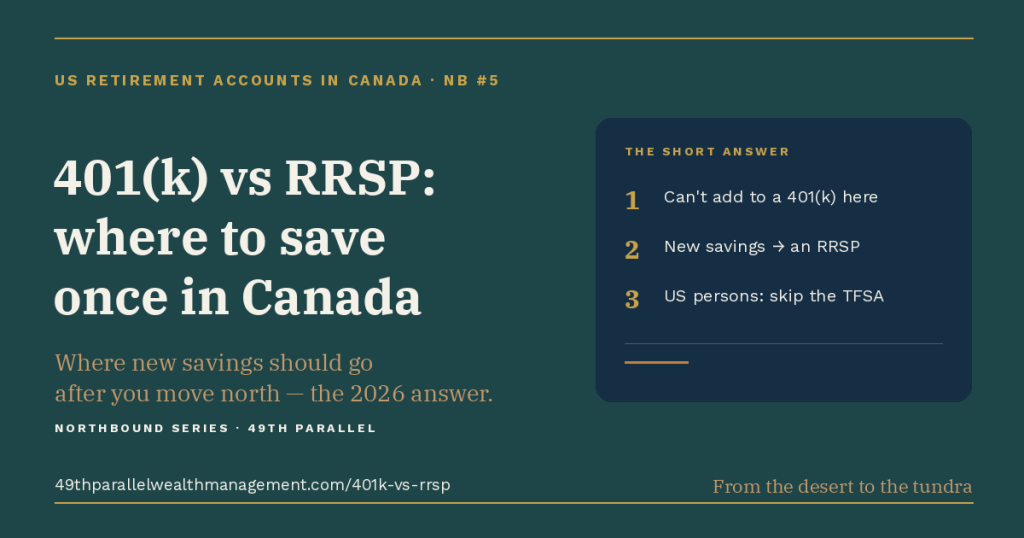
Once you’ve moved north and settled into a Canadian job, the retirement-savings question quietly changes shape. The real issue in the 401k vs RRSP decision isn’t which account is “better” in the abstract — it’s that, as a Canadian resident, you usually can’t add to a US 401(k) anymore, so the practical choice for new savings is the RRSP. Knowing why, and how the two accounts compare, keeps you from leaving free money and treaty benefits on the table.
Both the 401(k) and the RRSP do the same core job: you contribute pre-tax dollars, the money grows tax-deferred, and you pay tax when you withdraw in retirement. They are close cousins by design. But your tax residency — not the account’s features — is what decides where your next contribution can actually go. For a US citizen or green-card holder living in Canada, that answer comes with a few cross-border wrinkles worth getting right.
Can you still contribute to a 401(k) after moving to Canada?
In most cases, no. Employee 401(k) contributions require US-source earned income and an employer that sponsors the plan and runs its payroll. If you now work for a Canadian employer, there is no 401(k) to defer into — the plan belongs to a former US job. Your existing 401(k) doesn’t disappear: it stays invested, and with the right treaty position its growth remains tax-deferred on both sides of the border. But new money has to find a new home.
That’s why, for a Canadian resident, the honest framing isn’t “should I fund my 401(k) or my RRSP?” It’s “my 401(k) is now a legacy account — where do my ongoing retirement savings go?” We cover what happens to that legacy 401(k) in what happens to your 401(k) when you move to Canada, and whether to move it in our guide to transferring a 401(k) into an RRSP.
How do a 401(k) and an RRSP actually compare?
Structurally they rhyme, but the details differ. Here’s the 2026 picture, per the IRS and the Canada Revenue Agency:
|
Feature |
401(k) — United States |
RRSP — Canada |
|
2026 contribution limit |
$24,500 employee deferral; +$8,000 catch-up at 50+; a larger catch-up at ages 60–63; total additions capped at $72,000 |
18% of prior-year earned income, up to $33,810, minus any pension adjustment |
|
Tax treatment of contributions |
Pre-tax; reduces US taxable income |
Deductible against Canadian income — and, under the treaty, often deductible on a US return too |
|
Employer match |
Common; “free” matching contributions |
Via a group RRSP, DPSP, or registered pension plan — same idea |
|
Who can contribute now |
Only with US-source earned income + a sponsoring US employer |
Any Canadian resident with earned income and contribution room |
|
Winding down |
Required minimum distributions begin at age 73 |
Convert to a RRIF by the end of the year you turn 71; withdrawals start the year after |
The headline difference for someone building savings in Canada: you can open and fund an RRSP today, and you almost certainly can’t do the same with a 401(k). That alone usually settles the “where” question.
Which should a US person in Canada save into?
For a dual citizen or American living in Canada, the RRSP has three advantages that make it the natural home for new retirement savings — and they’re the reasons we steer US persons toward it rather than the tempting-but-treacherous TFSA:
- The treaty respects it. Under Article XVIII of the Canada–US tax treaty, a US citizen resident in Canada can defer US tax on income accruing inside an RRSP and, within limits, often deduct RRSP or employer-plan contributions on the US return as well. One contribution can reduce your tax bill in both countries.
- No PFIC landmine. Canadian mutual funds and ETFs held in a taxable or TFSA account are treated by the IRS as PFICs, triggering punitive tax and Form 8621. Holdings inside an RRSP are generally shielded from that treatment.
- Employer match is free money. If your Canadian employer offers a group RRSP, DPSP, or pension match, capturing it is almost always the highest-return move available — exactly as maxing a 401(k) match was back home.
The account to avoid is the TFSA. It looks like a Roth, but the IRS doesn’t recognize it, and it creates foreign-trust and PFIC reporting headaches for US persons. We lay out that trap in how the IRS taxes a TFSA, and the account that does survive the border in keeping your Roth IRA tax-free after moving to Canada.
THE CORE IDEA Once you’re a Canadian resident, the 401(k) vs RRSP question usually answers itself: the 401(k) is closed to new contributions, and the RRSP is both available and treaty-friendly. Fund the RRSP (grab any employer match first), leave the 401(k) invested, and keep US persons well clear of the TFSA.
What about the 401(k) you already have?
Leaving it where it is is often the right call. A US 401(k) or IRA can stay invested and, under the treaty, keep deferring tax while you’re a Canadian resident — no forced action the moment you cross the border. Whether it makes sense to eventually roll it into an RRSP is a separate, case-by-case decision that turns on withholding tax, foreign tax credits, and currency; we walk through it in should you move your 401(k) into a Canadian RRSP? How you eventually draw down the 401(k), IRA, RRSP, and RRIF together — and in what order — is its own planning question, covered in which account to spend first.
What this means for cross-border clients
If you’ve moved to Canada and are earning here, treat your 401(k) as a legacy asset to manage, not a bucket to keep filling. Direct new retirement savings into an RRSP — starting with any employer match — claim the treaty benefits you’re entitled to on both tax returns, and steer clear of the TFSA if you’re a US person. The wrong account choice can cost you a US deduction, trigger PFIC reporting, or leave an employer match unclaimed. This piece sits within our full US retirement accounts in Canada guide and our cross-border retirement planning service.
Frequently asked questions
Can I keep contributing to my 401(k) after moving to Canada?
Usually not. Employee 401(k) contributions require US-source earned income and an employer that sponsors the plan. If you now work for a Canadian employer, you generally can’t add new money to a US 401(k). The account stays invested and can keep its treaty-deferred status; new savings typically go into an RRSP or employer group plan instead.
Is an RRSP better than a 401(k) for someone living in Canada?
For new savings while you’re a Canadian resident, the RRSP is the practical choice because you generally can’t contribute to a 401(k) anymore. Both are tax-deductible, tax-deferred accounts. A US citizen in Canada can often deduct RRSP contributions on both returns under the treaty, and RRSPs avoid the PFIC problems that make a TFSA a poor fit for US persons.
Can a US citizen deduct RRSP contributions on their US tax return?
In many cases, yes. Article XVIII of the Canada–US treaty lets a US citizen resident in Canada defer US tax on income earned inside an RRSP and, within limits, claim a US deduction for contributions to an RRSP or Canadian employer plan. The limits are technical — confirm with a cross-border accountant.
What are the 2026 contribution limits for a 401(k) and an RRSP?
For 2026 the 401(k) employee deferral limit is $24,500, with an $8,000 catch-up at 50+ and a larger catch-up at ages 60–63. The RRSP limit is 18% of prior-year earned income up to $33,810, reduced by any pension adjustment. Verify current figures with the IRS and CRA before acting.
Book a free consultation:
Introductory meeting (Calendly) | Get the book
Sources
- 401(k) contribution limits — Internal Revenue Service
- RRSP contribution room and deduction limit — Canada Revenue Agency
- Canada–U.S. Tax Convention (Article XVIII) — Department of Finance Canada
- Publication 597, U.S.–Canada Income Tax Treaty — Internal Revenue Service
- Required minimum distributions (RMDs) FAQs — Internal Revenue Service
- Receiving income from an RRSP (converting to a RRIF) — Canada Revenue Agency
Lucas Wennersten
Cross-Border Financial Advisor · 49th Parallel Wealth Management
CFP® US & Canada
Founder
Author
Columnist
Lucas Wennersten is the founder of 49th Parallel Wealth Management and a dual-certified financial planner (CFP® US & Canada) and Chartered Financial Analyst (CFA). With a career spanning both Arizona and Toronto, Lucas brings firsthand experience navigating cross-border finances to every client relationship. He writes and speaks on wealth management, cross-border tax strategy, and retirement planning for Canadians and Americans living between two countries.
From the Desert to the Tundra™
