
Your TFSA Is Taxable in the United States
By: Lucas Wennersten Cross-Border Specialist
The Tax-Free Savings Account is one of Canada’s most effective financial planning tools. For Canadian residents, it is precisely what its name promises: a registered account in which investments grow free of Canadian tax, withdrawals carry no tax consequence, and contribution room accumulates year after year.
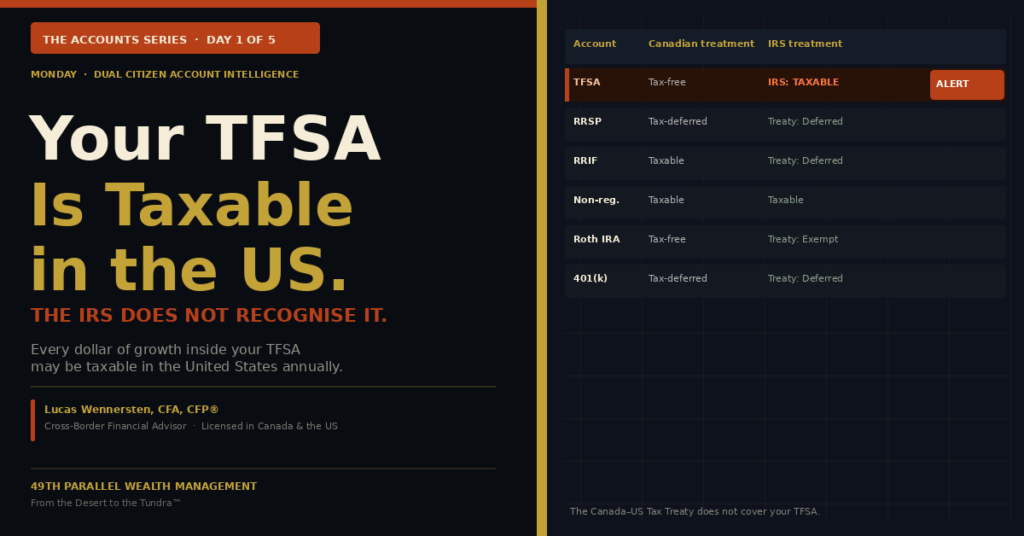
For dual citizens and US persons living in Canada, that promise is only half true.
The Canada–US Tax Treaty — which governs how the two countries treat each other’s registered accounts — explicitly covers the RRSP and RRIF, granting them tax deferral treatment in the United States. The TFSA is not mentioned in the Treaty. Not as an oversight, and not because the IRS grants it informal recognition. The TFSA simply does not exist in the Treaty’s framework. According to the IRS guidance on foreign accounts and trusts, a TFSA is treated as a standard taxable investment account for US tax purposes. Every dollar of interest, dividends, and capital gains earned inside the account is taxable in the United States in the year it is earned — regardless of whether the money is ever withdrawn.
If you are a dual citizen, a green card holder, or a Canadian who has triggered US tax residency through the Substantial Presence Test, and you hold a TFSA, this is not a planning consideration for the future. It is likely a current filing obligation that deserves immediate attention.
Why the Treaty Is Silent on TFSAs
The Canada–US Tax Treaty was last substantially updated in 2007 — two years before the TFSA was introduced by the Canadian government in 2009. The Treaty’s silence on TFSAs is therefore architectural rather than deliberate: the account simply did not exist when the relevant provisions were negotiated.
There has been significant discussion in cross-border tax circles about whether a future Treaty update might extend TFSA recognition similar to RRSP treatment. As of 2026, no such update has been enacted. The IRS position remains unchanged: the TFSA is not a recognized pension or retirement vehicle under the Treaty, and its income is fully taxable to US persons on an accrual basis.
This is not a grey area. It is a settled IRS position supported by substantial professional guidance, including from the Canadian Department of Finance and multiple cross-border tax authorities.
What “Taxable in the US” Actually Means for Your Account
The practical consequences depend on what you hold inside your TFSA. The IRS taxation applies at the investment level, and different asset types carry different compliance implications.
Cash and GICs
Interest income earned inside a TFSA on cash deposits and guaranteed investment certificates is straightforwardly taxable in the US in the year it accrues. The reporting is relatively clean — the interest is declared as foreign interest income on your US return.
Individual stocks and ETFs
Dividends and capital gains from individual Canadian or US equities held inside a TFSA are taxable in the US in the year they are realised or received. US-listed ETFs held inside the account generally do not trigger additional filing complexity, though gains are still taxable. Reporting is more complex than cash but manageable with proper record-keeping.
Canadian mutual funds and pooled products
For a dual citizen holding a TFSA with multiple Canadian mutual funds built up over years, the Form 8621 filing requirement alone can represent a significant annual compliance cost — before accounting for the underlying US tax liability.
|
The TFSA compliance stack for US persons · Annual US income tax on interest, dividends, and capital gains earned inside the account · Form 8621 required annually for each Canadian mutual fund or PFIC held · FBAR (FinCEN 114) filing required if total foreign financial accounts exceed USD $10,000 · FATCA Form 8938 required if foreign financial assets exceed applicable thresholds · Potential exposure to PFIC excess distribution rules if elections not made correctly |
The Revenue Procedure 2020-17 Question
Some dual citizens have encountered references to IRS Revenue Procedure 2020-17, which provided compliance relief for certain Canadian registered accounts — specifically RESPs and RDSPs — from foreign trust reporting requirements. A natural question is whether this relief extends to TFSAs.
The answer is nuanced. Revenue Procedure 2020-17 does provide potential relief from the formal foreign trust filing requirements (Forms 3520 and 3520-A) for TFSAs that meet certain criteria — specifically, that they qualify as “tax-favored foreign trusts” under the relevant standard. Cross-border tax professionals have reached different conclusions on whether TFSAs consistently meet that threshold.
What the Revenue Procedure does not change is the underlying US taxability of TFSA income. Even if Form 3520 filing is not required, the income earned inside the account remains fully taxable to US persons in the year it is earned. The compliance simplification, where it applies, reduces the filing burden — it does not eliminate the tax obligation.
|
Client Scenario David is a dual citizen who has lived in Toronto for fifteen years following a decade working in Seattle. He has contributed to his TFSA consistently since 2009 and has accumulated $94,000 in the account, primarily in a mix of Canadian equity mutual funds and a dividend-focused ETF. When David engaged a cross-border advisor for the first time in 2025, the review surfaced several years of unfiled Form 8621 obligations for the mutual funds, annual TFSA income that had not been declared on his US returns, and potential FBAR exposure. The remediation process — working with a cross-border CPA to address the historic filing gaps — took several months. David’s situation is not unusual. It is, in fact, the default outcome for dual citizens who received only Canadian financial advice on their TFSA. |
What to Do If You Hold a TFSA as a US Person
The answer is not automatically to close the account. The decision depends on the size of the TFSA, its holdings, your overall US tax position, and the relationship between Canadian tax-free growth and US annual tax exposure. For some dual citizens, maintaining a carefully structured TFSA still makes sense. For others, the compliance cost and tax drag make alternative structures more efficient.
The first step is an accurate assessment of your current position — what the account holds, what filing obligations have been met, and what exposure exists from prior years. From there, the planning options include:
- Restructuring the TFSA holdings to minimize PFIC exposure and reduce annual US tax drag
- Addressing any historic filing gaps through a voluntary disclosure process with the IRS
- Coordinating TFSA withdrawals with a broader cross-border account strategy that prioritizes the most tax-efficient structure across both jurisdictions
- In some cases, winding down the TFSA and redeploying those assets into structures with better cross-border tax treatment
What does not serve dual citizens well is leaving the situation unaddressed. The TFSA is a high-profile account type that cross-border tax authorities are familiar with. As the IRS’s enforcement of foreign account reporting has expanded under FATCA, the TFSA has become an increasingly common discovery in cross-border compliance reviews. Proactive planning is significantly less costly than remediation.
The Broader Picture: Your Accounts Are Not What You Think
The TFSA is the starting point for this week’s series, not because it is the most complex cross-border account question — it is not — but because it is the most common source of surprise for dual citizens who have operated under Canadian-only advice. Tomorrow we turn to the RRSP, which is more complex in both structure and Treaty treatment, and where the planning stakes for a HNW portfolio are considerably higher.
The through-line across the week is this: dual citizens and long-term cross-border residents need Canada–US financial planning that accounts for both systems simultaneously. An advisor who understands only one side of the border cannot give you a complete picture. For your TFSA, your RRSP, your filing obligations, and your overall account strategy — the two systems must be seen together, not in isolation.
Frequently Asked Questions
Q1-Is a TFSA taxable in the United States?
Yes. The IRS does not recognize the Tax-Free Savings Account as a tax-sheltered vehicle. Because the Canada–US Tax Treaty is silent on TFSAs, income earned inside the account — interest, dividends, and capital gains — is taxable to a US person annually, regardless of whether funds are withdrawn. This applies to dual citizens, green card holders, and anyone meeting the Substantial Presence Test.
Q2- Does the Canada-US Tax Treaty protect the TFSA?
No. The Treaty explicitly covers RRSPs and RRIFs, granting them tax deferral treatment in the US. TFSAs are not mentioned — the account was created in 2009, two years after the Treaty’s last major update. The IRS therefore treats the TFSA as a standard taxable investment account.
Q4-What happens if my TFSA holds Canadian mutual funds?
Canadian mutual funds held inside a TFSA are likely classified as Passive Foreign Investment Companies (PFICs) under US tax law. PFIC reporting — primarily Form 8621 — applies per fund, per year, and the default tax treatment on gains can be punitive. This is a significant compliance burden that many dual citizens are unaware of.
Q5-Should I close my TFSA as a US person?
Not necessarily — the decision requires analysis of the account size, holdings, your overall tax position, and prior filing compliance. Whether to keep, restructure, or wind down the account is a planning question that should be addressed with a cross-border advisor who holds credentials in both jurisdictions.
Q6-What should I hold in my TFSA if I am a US person?
If you choose to maintain a TFSA, the most straightforward approach is to hold assets that minimize PFIC exposure: individual stocks, GICs, or Canadian-listed ETFs structured to avoid PFIC classification. Avoid Canadian mutual funds and pooled investment products inside the account. A cross-border advisor can help you structure holdings to reduce US reporting complexity.
Q7-Is your TFSA costing you more than you think in the US?For dual citizens and long-term cross-border residents, account-level decisions have consequences in two tax systems simultaneously. Lucas Wennersten holds dual credentials as a CFA and CFP® in both Canada and the United States and works exclusively with clients whose financial lives span both countries. If you have never had a coordinated cross-border account review, this week’s series is your prompt to do so. Book a complimentary consultation at 49thparallelwealthmanagement.com/contact-us/ |
============================================================ –>
Lucas Wennersten
Cross-Border Financial Advisor · 49th Parallel Wealth Management
CFP® US & Canada
Founder
Author
Columnist
Lucas Wennersten is the founder of 49th Parallel Wealth Management and a dual-certified financial planner (CFP® US & Canada) and Chartered Financial Analyst (CFA). With a career spanning both Arizona and Toronto, Lucas brings firsthand experience navigating cross-border finances to every client relationship. He writes and speaks on wealth management, cross-border tax strategy, and retirement planning for Canadians and Americans living between two countries.
Crossing the 49th Parallel: A Retirement Planning Guide for Moving Across the Canada–U.S. Border
crossingthe49thparallel.com
From the Desert to the Tundra™
