Election to Stop Contributing to CPP in Canada: Rules, Process, and Impact on Benefits
In Canada, contributing to the Canada Pension Plan (CPP) is mandatory for most working Canadians. However, there is a little-known election that allows certain individuals to stop contributing, even while they continue working.
Understanding who qualifies, how to elect out, when the election takes effect, and how it affects CPP benefits is critical, especially for Canadians working past age 65 or receiving CPP while still employed.
This guide explains the rules clearly, without jargon.
Who Can Elect to Stop Contributing to CPP?
You cannot opt out of CPP at any age, but you can elect to stop contributing if all the following conditions are met:
You must:
- Be age 65 to 70, and
- Be receiving CPP retirement benefits, and
- Continue to have employment or self-employment income
If you are under 65, CPP contributions are mandatory.
If you are over 70, CPP contributions automatically stop, no election required.
Why This Election Exists
Normally, Canadians who work while receiving CPP between ages 65 and 70 continue to contribute, which creates a Post-Retirement Benefit (PRB) — an additional lifetime CPP benefit.
The election to stop contributing exists because:
- Not all workers benefit meaningfully from additional CPP accruals
- Some individuals prefer higher net pay today
- CPP contributions are not refundable once paid
This election allows for intentional planning, rather than default participation.
How to Elect to Stop CPP Contributions (Form CPT30)
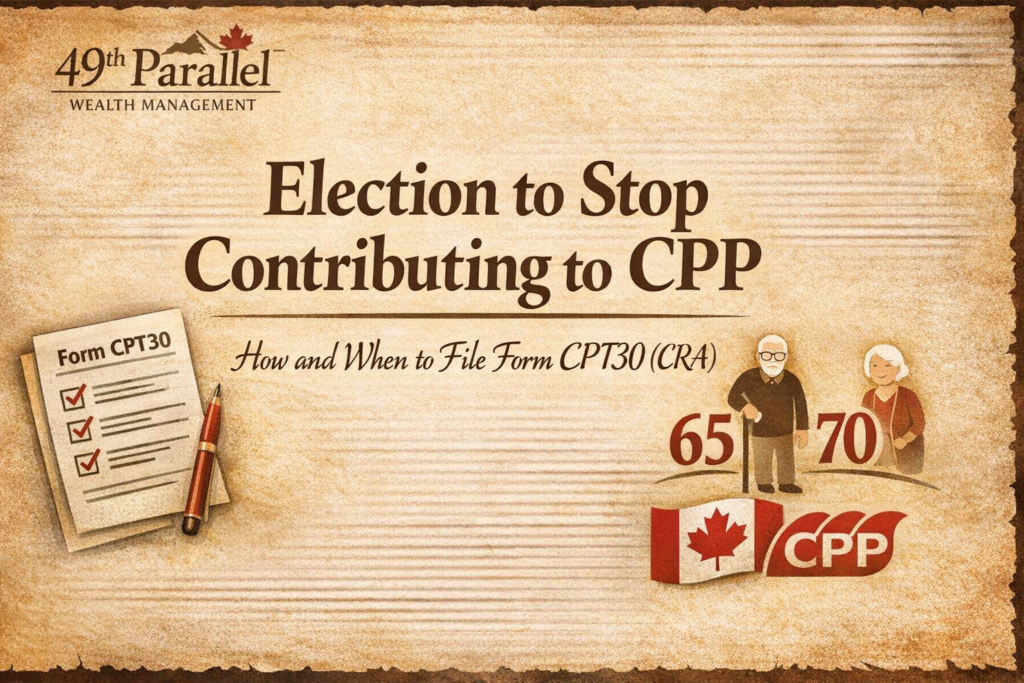
The election is made by filing Form CPT30 – Election to Stop Contributing to the Canada Pension Plan.
Step-by-Step Process
- Confirm eligibility
- Age 65–70
- Actively receiving CPP retirement benefits
- Complete Form CPT30
- Available on the CRA website
- Must be signed and dated
- Submit the form
- Send to the Canada Revenue Agency (CRA)
- Provide a copy to each employer
- Self-employed individuals file it with their tax return
- Employer action
- Once received, employers must stop CPP deductions
- Contributions cease for both employee and employer portions
When Does the Election Take Effect?
Timing matters.
- The election becomes effective the month after CRA receives Form CPT30
- CPP contributions made before the effective date cannot be refunded
- Once in effect, CPP contributions stop until you revoke the election
This makes early planning essential.
Can the Election Be Revoked?
Yes, but only once.
- You may revoke the election one time
- Revocation must be filed using Form CPT30
- After revocation, CPP contributions resume until age 70
After age 70, contributions stop permanently.
How Stopping CPP Contributions Affects Your Benefits
If You Continue Contributing (No Election)
- Contributions create Post-Retirement Benefits (PRBs)
- PRBs:
- Increase CPP income for life
- Are inflation-indexed
- Cannot be reversed once earned
If You Elect to Stop Contributing
- No further CPP accruals
- No additional PRBs
- Higher net income from employment
- Employer also saves their CPP portion
The decision becomes a trade-off between future guaranteed income and present-day cash flow.
Who Should Consider the Election Carefully?
This election is especially relevant for:
- High-income earners over 65
- Business owners and incorporated professionals
- Individuals with strong retirement income from other sources
- Those prioritizing cash flow over marginal CPP increases
It may be less beneficial for:
- Those with limited retirement savings
- Individuals relying heavily on CPP income
- Those with long life expectancy who value inflation-indexed income
Common Planning Mistakes
- Assuming CPP contributions automatically stop at 65
- Filing CPT30 too late and missing months of potential savings
- Not informing employers properly
- Failing to assess PRB value versus contribution cost
CPP elections are permanent in effect — mistakes are costly.
Frequently Asked Questions (FAQ)
 alt=”” width=”1536″ height=”1024″ />
Can I stop contributing to CPP before age 65?
No. CPP contributions are mandatory until age 65.
Do CPP contributions stop automatically at 65?
No. Contributions continue unless you are receiving CPP and file Form CPT30
Do CPP contributions stop at age 70?
Yes. CPP contributions automatically stop at 70, regardless of employment status.
Is opting out of CPP permanent?
The election can be revoked once before age 70.
Does my employer need a copy of CPT30?
Yes. Employers must receive a copy to stop payroll deductions.
Does stopping CPP affect Old Age Security (OAS)?
No. CPP elections do not impact OAS eligibility or benefits.
Key Takeaways
- CPP opt-out is available only from age 65–70
- You must be receiving CPP benefits
- Election is made using Form CPT30
- Stopping contributions increases cash flow but reduces future CPP income
- Proper timing and planning are essential
