
How Long Can a Canadian Stay in the United States?The 182-day rule, the Substantial Presence Test, and the three-year formula that catches experienced snowbirds off guard — explained with precision. By Lucas Wennersten, CFP® (US & Canada), CFA — Founder, 49th Parallel Wealth Management — April 2026 — Reading time: 10 minutes |
|
IMPORTANT DISCLAIMER This article is for general informational and educational purposes only. It does not constitute legal, tax, immigration, or financial advice, and should not be relied upon as such. Cross-border tax and immigration rules are complex, change frequently, and depend heavily on individual circumstances. Nothing in this article creates a client relationship with 49th Parallel Wealth Management. If your situation involves significant US presence, US property ownership, US-sourced income, or consideration of a permanent move, consult a qualified cross-border tax advisor and, where appropriate, an immigration attorney before making any decisions. |
Every year, hundreds of thousands of Canadians spend part of their year in the United States. Arizona, Florida, California, Texas — the sunbelt has been welcoming Canadian snowbirds for decades. And every year, a meaningful number of them make errors that have real consequences: tax filings that should have been made, day counts that were quietly exceeded, and IRS thresholds crossed without any awareness that a threshold existed.
This article covers two distinct but frequently confused rules. The first is the 182-day rule — an informal threshold rooted in US immigration practice that governs how long a Canadian can be physically present in the United States as a temporary visitor. The second is the IRS Substantial Presence Test — a tax residency calculation that operates independently of immigration status and that uses a weighted three-year formula most Canadians have never seen.
Understanding both, and understanding how they interact, is foundational to any well-structured cross-border life.
Part One: The 182-Day Rule
The 182-day rule is best understood as an immigration guideline, not a codified statutory limit. Canadian citizens do not require a visa to enter the United States. Under the terms of the longstanding Canada–US relationship and the Visa Waiver Program framework, Canadians may enter as temporary visitors for tourism, family visits, and leisure without obtaining advance authorisation beyond a valid passport.
However, being admitted as a temporary visitor comes with an implicit expectation: that the visitor is not living in the United States. US Customs and Border Protection (CBP) uses 182 days — just under six months — as the informal outer limit of what constitutes a temporary stay. This threshold is not written into US statute as a precise legal maximum, but it is the threshold CBP officers apply in practice, and exceeding it creates serious immigration risk.
Why 182 Days Specifically?
The 182-day figure is not arbitrary. It exists because 183 days is the minimum current-year presence required for the IRS Substantial Presence Test to apply. By convention, 182 days keeps Canadian visitors one day below the floor of the IRS calculation — though, as explained in Part Two, this provides less protection than most people assume.
How Days Are Counted
This is the first area where many Canadians are surprised. The United States does not count days on a calendar-year basis. The 182-day assessment operates on a rolling 12-month period. If you entered the United States on November 15, the relevant window runs through November 14 the following year — not to December 31.
Every day of physical presence in the United States counts as one full day, regardless of when you crossed the border. A day trip — driving across for groceries, attending an appointment, visiting a friend — counts as a full US day. Transit days count. Partial days count.
|
COMMON MISCONCEPTION Many Canadians believe that a brief return to Canada — a weekend trip, a medical appointment, a family visit — resets their 182-day clock. It does not. The rolling 12-month count is cumulative across all entries during the window. Leaving and returning does not restart anything. |
The I-94 Record
Every entry into the United States generates an I-94 record — your official record of admission. This record captures your entry date, port of entry, and the terms of your admission, including your admitted-until date. The admitted-until date is the legal deadline by which you must depart. It may be less than 182 days from your entry if the CBP officer has concerns about your stay pattern.
You can view your current and historical I-94 records at any time through the CBP website at i94.cbp.dhs.gov. If you are uncertain about your cumulative US presence, your I-94 history is the most reliable starting point. Errors in I-94 records do occur, and discrepancies are significantly easier to correct before they become embedded in your travel history.
How the US Tracks Your Days
|
ON TRACKING AND ENFORCEMENT Since 2021, US Customs and Border Protection has materially upgraded its entry and exit tracking infrastructure. While a fully automated exit-tracking system does not yet exist at all land border crossings, CBP uses passport scans, I-94 records, and data-sharing arrangements with Canada Border Services Agency to monitor the length of visitor stays. The assumption that days are not being tracked is not a sound basis for planning. |
Consequences of Overstaying
Overstaying your admitted-until date, or accumulating more than 182 days in a rolling 12-month period, is treated seriously by US immigration authorities. Consequences include:
- Enhanced border scrutiny: Future crossings may involve secondary inspection and additional questioning on a recurring basis
- Denial of entry: CBP has statutory authority to deny entry to anyone it determines has previously overstayed
- Multi-year bars: Overstays of more than 180 days can result in a three-year bar from entering the United States. Overstays exceeding one year can result in a ten-year bar
- Impact on future immigration applications: Any overstay history is considered in the assessment of future US visa or immigration applications
Part Two: The IRS Substantial Presence Test
The Substantial Presence Test (SPT) is a tax residency determination mechanism used by the Internal Revenue Service. It operates entirely independently of your immigration status. You can be well within the 182-day immigration guideline and still meet the SPT threshold. You can be a temporary visitor for immigration purposes and simultaneously be treated as a US tax resident by the IRS.
This is the part of the picture that most Canadian snowbirds have not been told about — and the consequences of not knowing it are not trivial.
The SPT Formula: A Three-Year Weighted Calculation
Unlike the 182-day rule, which looks at a rolling 12-month window, the Substantial Presence Test uses a weighted calculation that spans three calendar years. You meet the SPT — and may be treated as a US tax resident for the current year — if both of the following conditions are satisfied:
- You were present in the United States for at least 31 days during the current calendar year, AND
- Your weighted three-year total equals or exceeds 183 days
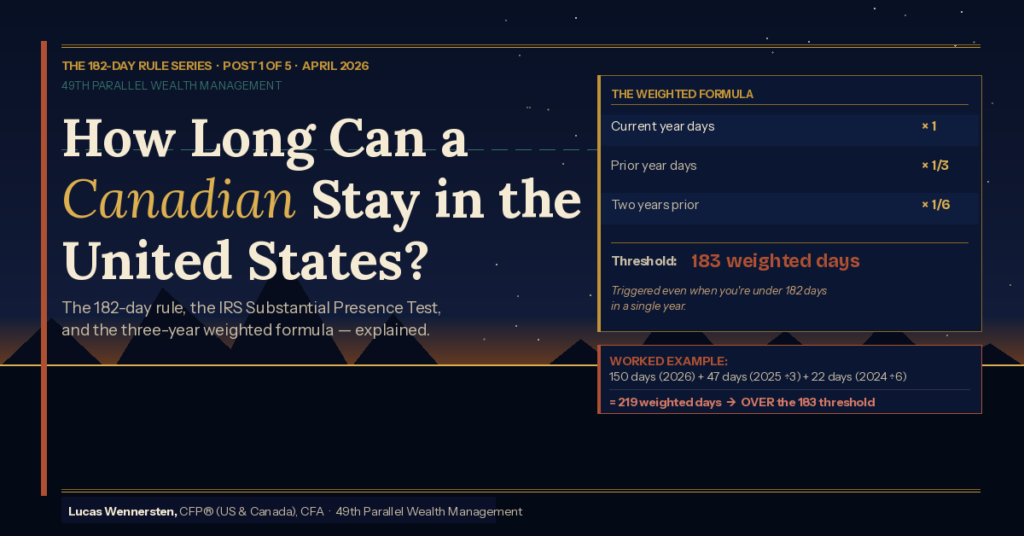
The weighting formula is applied as follows:
| Year | Multiplier | What This Means |
| Current year | × 1 (full count) | Every day you spent in the US this year counts in full |
| Prior year (1 year ago) | × 1/3 | One-third of last year’s days are added to your current total |
| Two years prior | × 1/6 | One-sixth of days from two years ago are added |
Your weighted total is the sum of: all current-year days, plus one-third of prior-year days, plus one-sixth of days from two years prior. If this weighted total reaches 183 or more, and you were present for at least 31 days in the current year, the IRS considers you a US tax resident for that year.
A Worked Example: Why This Catches Experienced Snowbirds
Consider a Canadian who has been gradually extending their US winters over three years. In any individual year, their stay is comfortably under 182 days. The SPT formula tells a different story:
| Tax Year | Days in US | Multiplier | Weighted Days |
| 2024 (two years prior) | 130 days | × 1/6 | 22 weighted days |
| 2025 (prior year) | 140 days | × 1/3 | 47 weighted days |
| 2026 (current year) | 150 days | × 1 | 150 weighted days |
| Total | 219 weighted days — OVER the 183 threshold |
This Canadian spent 150 days in the US in 2026 — well within what most people would consider a safe limit. But their weighted SPT total is 219 days. Without filing the appropriate protective declaration with the IRS, they may be treated as a US tax resident for the 2026 tax year.
|
THE CRITICAL INSIGHT The SPT does not evaluate only what you did this year. It evaluates a rolling three-year pattern. A gradual, innocent increase in the length of your annual stays — 120 days, then 130, then 140 — can push your weighted total over the threshold even when each individual year appears safely within limits. This is precisely why the SPT catches people who believe they are being careful. |
What US Tax Residency Actually Means
If the IRS determines that you are a US tax resident under the SPT, the implications are significant. As a US tax resident, you would generally be required to file a US federal tax return reporting your worldwide income — not just income earned in the United States. You may also have reporting obligations for foreign financial accounts and assets. US tax law is broad in its reach, and the consequences of non-compliance compound over time.
It is important to note that tax residency under US law is a separate and distinct determination from tax residency under Canadian law. Being a US tax resident under the SPT does not make you a non-resident of Canada for Canadian tax purposes. You may, in certain circumstances, be considered a tax resident of both countries simultaneously — a situation that requires careful navigation of the Canada–US Tax Convention.
Part Three: The Closer Connection Exception
The Internal Revenue Code provides a mechanism by which individuals who technically meet the Substantial Presence Test can avoid being classified as US tax residents, provided they can demonstrate that their genuine home and primary connections remain in Canada. This is called the Closer Connection Exception.
The Closer Connection Exception is documented and claimed by filing IRS Form 8840, the Closer Connection Exception Statement for Aliens. Filing this form annually is how you establish with the IRS that, despite meeting the mathematical threshold of the SPT, you are not a US resident in any meaningful sense — your home, your family, your financial life, and your social ties remain in Canada.
What the IRS Examines
In evaluating a Closer Connection claim, the IRS considers the following factors. The strength of your position depends on how clearly your life is centred in Canada across each dimension:
| What the IRS examines | What strengthens your Canadian position |
| Location of your primary home | You own or rent your principal residence in Canada |
| Where your family lives | Spouse and dependents are in Canada |
| Location of bank accounts and assets | Primary financial accounts are Canadian-held |
| Where you are registered to vote | You vote in Canadian federal or provincial elections |
| Driver’s licence jurisdiction | You hold a Canadian provincial licence |
| Primary tax return filed | You file a T1 with the Canada Revenue Agency |
| Professional and social ties | Memberships, licences, and associations are Canadian |
Who Should File Form 8840
|
FORM 8840 GUIDANCE If you spend more than 120 days per year in the United States and have done so for more than one year, you should discuss Form 8840 with a qualified cross-border tax advisor. The form is typically due by June 15 of the following year for Canadians with no US-sourced income. It is not a tax return. It is a protective declaration that establishes your position with the IRS. Failing to file when the circumstances require it is a meaningfully worse outcome than filing when it was not strictly necessary. |
Critical Limitations of the Exception
The Closer Connection Exception is not available in all circumstances. Specifically, it cannot be claimed if:
- You were physically present in the United States for 183 or more days in the current calendar year (not the weighted total — the actual count), OR
- You have taken steps toward obtaining lawful permanent resident status in the United States (i.e., a green card application is pending or has been approved)
|
IF EITHER CONDITION APPLIES TO YOU If you were present in the US for 183 or more actual days in the current year, or if you are in the process of obtaining US permanent residency, the Closer Connection Exception is not available to you. These situations require immediate consultation with a qualified cross-border tax advisor. The Canada–US Tax Convention may provide alternative relief in some circumstances, but this is not a determination to make without professional guidance. |
Part Four: When the Picture Becomes More Complex
If You Own US Property
Property ownership in the United States does not alter your permitted length of stay. Owning a condominium in Arizona or a home in Florida confers no additional immigration right of admission. However, US property ownership creates a distinct and often underappreciated set of cross-border considerations, including potential exposure to US federal estate tax on non-residents who hold US situs assets above certain thresholds, and reporting obligations that vary depending on how the property is held.
The intersection of US property ownership and Canadian residency is an area where the gap between what people assume applies to them and what actually applies to them is frequently significant.
If You Are Considering a More Permanent Move
Some Canadians arrive at a point where they want to spend more than six months per year in the United States, or to relocate permanently. This is a meaningful life transition that involves immigration status, tax residency on both sides of the border, retirement account treatment, healthcare, and estate planning across two legal systems. It is also a transition that many people have navigated successfully — but the difference between a well-structured transition and a poorly planned one is substantial, and the planning needs to begin before the move, not after.
If You Are a US Citizen Living in Canada
US citizens living in Canada are subject to a fundamentally different set of rules. The 182-day limit does not apply to US citizens entering their own country. However, US citizens living in Canada face ongoing tax filing obligations in both countries regardless of where they reside, and may have FBAR and FATCA reporting requirements related to Canadian financial accounts. This is a distinct situation from the snowbird scenario, and it requires its own planning framework.
Practical Steps for Anyone Spending Extended Time in the US
Regardless of how long you have been doing this, the following practices reduce your exposure to the errors that create the most serious problems:
- Keep a day count log: A note in your phone recording every entry and exit date. Takes seconds and produces a complete record if you ever need it
- Set a 160-day personal limit: Build a 20-day buffer below the 182-day threshold. This accommodates unexpected delays, medical situations, and border processing issues without risking an overstay
- Check your I-94 record at the start and end of each season: Log in at i94.cbp.dhs.gov and confirm all entries and exits are recorded accurately. Discrepancies are easier to correct early
- Track your day count across all three years for the SPT: Maintain a running record of actual US days for the current year and the two prior years. Run the weighted calculation before each season to understand where you stand
- Know your I-94 admitted-until date: This is your legal departure deadline. It may differ from 182 days from your entry. Know it. Leave before it
- Consult a cross-border tax advisor if your weighted SPT total approaches 150: At that level you have limited margin. Advice before the season is worth considerably more than advice after a threshold has been crossed
The Rest of This Week’s Series
This post is the foundation. The four posts that follow this week build on it, moving from the rules themselves to what they mean for the real decisions Canadian snowbirds are navigating right now.
- Tuesday: You Can Stay 182 Days — But Can You Afford To? The real cost of the cross-border lifestyle that nobody budgets for
- Wednesday: You Are Not the Only One Doing This. The global retirement migration shift and why the cross-border life is increasingly the norm
- Thursday: What Nobody Tells Canadians Before Their First Full Winter in the US. Banking, mail, healthcare, and the practical surprises
- Friday: So You Want to Make It Official. What cross-border life actually requires when you are ready to stop improvising and start planning
Frequently Asked Questions
How long can a Canadian stay in the United States without a visa?
Canadian citizens may enter the United States as temporary visitors without a visa. US Customs and Border Protection applies an informal limit of 182 days in any rolling 12-month period. This is not a guaranteed right — CBP officers may grant a shorter admission period at their discretion, and your I-94 admitted-until date is the legal deadline that governs your stay, not the 182-day figure itself.
Does a short trip back to Canada reset the 182-day clock?
No. This is one of the most persistent misconceptions among Canadian snowbirds. The United States counts days on a rolling 12-month basis, not a calendar year. A weekend in Ontario and back does not restart anything. Your cumulative total of US days continues to accumulate across every entry during that rolling window. Day trips — crossing the border to shop, visit family, or attend an appointment and returning the same day — also count as full US days.
What is the IRS Substantial Presence Test and how does it differ from the 182-day rule?
These are two separate rules that are frequently confused. The 182-day rule is an immigration guideline — it governs how long you can be physically present in the United States as a temporary visitor. The Substantial Presence Test (SPT) is a tax residency calculation used by the IRS. It operates independently of your immigration status and uses a weighted three-year formula. You can be comfortably under 182 days in the current year and still meet the SPT threshold — which is why understanding both is essential.
How is the Substantial Presence Test actually calculated?
The SPT uses a three-year weighted formula. Your weighted total equals all of your current-year US days (counted in full), plus one-third of your prior-year US days, plus one-sixth of your US days from two years prior. If this weighted total reaches 183 or more, and you were present in the US for at least 31 days in the current year, the IRS considers you a US tax resident for that year. A Canadian who spent 150 days in 2026, 140 days in 2025, and 130 days in 2024 would have a weighted total of 219 days — over the threshold — despite spending well under 182 days in any single year.
What does it mean to be a US tax resident under the Substantial Presence Test?
If the IRS determines you are a US tax resident under the SPT, you may be required to file a US federal tax return reporting your worldwide income — not just income earned in the United States. You may also have reporting obligations for foreign financial accounts and assets. US tax residency under the SPT is entirely separate from Canadian tax residency. In some circumstances you can be considered a tax resident of both countries simultaneously, which requires careful navigation of the Canada–US Tax Convention.
What is IRS Form 8840 and who needs to file it?
Form 8840 is the Closer Connection Exception Statement for Aliens. It allows Canadians who technically meet the SPT to avoid being classified as US tax residents by demonstrating that their genuine home, family, financial accounts, and social connections remain in Canada. If you spend more than 120 days per year in the United States and have done so for more than one year, you should discuss Form 8840 with a qualified cross-border tax advisor. The form is typically due by June 15 of the following year. It is not a tax return — it is a protective declaration that establishes your position with the IRS.
Can I still file Form 8840 if I spent more than 183 days in the US this year?
No. The Closer Connection Exception is not available if you were physically present in the United States for 183 or more actual days in the current calendar year — note this is your actual day count, not the weighted SPT total. It is also unavailable if you have taken any steps toward obtaining US permanent residency. If either situation applies to you, consult a qualified cross-border tax advisor immediately. The Canada–US Tax Convention may provide alternative relief in some circumstances, but this is not a determination to make without professional guidance.
What happens if I overstay my permitted time in the United States?
The consequences are serious and compound over time. Overstaying your I-94 admitted-until date can result in enhanced scrutiny at every future border crossing, denial of entry, and multi-year bars from the United States. Overstays of more than 180 days can trigger a three-year bar. Overstays of more than one year can result in a ten-year bar. Any overstay history is also weighed in future US visa or immigration applications. The I-94 admitted-until date — not the 182-day guideline — is your legal deadline.
Does owning property in the United States affect how long I can stay?
Owning a condominium in Arizona or a home in Florida does not grant you any additional right of admission or extend your permitted stay. Your property ownership has no bearing on the 182-day immigration guideline. However, US property ownership does create a separate set of cross-border considerations — including potential exposure to US federal estate tax for non-residents holding US situs assets above certain thresholds, and reporting obligations that vary depending on how the property is held. These are distinct from the day-count question and require their own planning framework.
How should I be tracking my US days?
Keep a running log of every entry and exit date — a note on your phone takes seconds at the border and gives you a complete record. Check your I-94 history at i94.cbp.dhs.gov at the start and end of each season and confirm all entries are recorded accurately. Track your actual day count across all three years so you can run the SPT weighted calculation before each season. Set a personal limit of 160 days rather than 182 — the 20-day buffer accommodates unexpected delays, medical situations, or extended border processing without putting you at risk. If your weighted SPT total is approaching 150, get advice before the season begins, not after.
|
FREE DOWNLOAD — AVAILABLE TOMORROW The Canadian Snowbird’s 2026 US Stay Checklist — a complete practical reference covering everything you need to do before, during, and after your 182 days in the United States, including a plain-language walkthrough of the Substantial Presence Test and the Form 8840 filing requirement. Available free tomorrow at 49thparallelwealthmanagement.com/snowbird-us-stay-checklist |
Working with a Cross-Border AdvisorIf you are spending significant time in the United States and want to ensure your cross-border situation is properly structured — the day count, the Substantial Presence Test, the property considerations, and everything that sits behind it — we are available to speak with you. 49th Parallel Wealth Management is one of the only firms in North America with dual registration as a Portfolio Manager in Canada and a Registered Investment Advisor in the United States. Lucas Wennersten holds the CFP® designation in both countries and the CFA designation. Book a complimentary introduction: 49thparallelwealthmanagement.com/contact-us |
49th Parallel Wealth Management — From the Desert to the Tundra — 49thparallelwealthmanagement.com — This article is for informational purposes only and does not constitute professional advice.
