
Exploring the Significance of the 49th Parallel
The 49th Parallel stands as a monumental testament to international diplomacy, symbolizing a demarcation line of profound significance in global geopolitics. As the principal latitude line delineating the border between the United States and Canada, the 49th Parallel is not merely a geographical marker but a historical and economic construct that has shaped North American relations profoundly. This exploration seeks to unravel the intricate tapestry of historical events and policies that have established the 49th Parallel as a critical element in the study of international relations and economic policy.
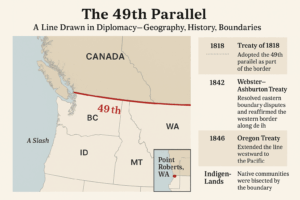
The inception of the 49th Parallel as a boundary can be traced back to the early 19th century, a period characterized by burgeoning territorial claims and diplomatic negotiations. The Treaty of 1818, a landmark agreement between the United States and Great Britain, played a pivotal role in establishing this boundary line. This treaty, a product of meticulous negotiation, sought to resolve territorial disputes that had emerged in the aftermath of the American Revolutionary War and the War of 1812. Both nations were eager to avoid further conflict and sought a solution that would be both practical and sustainable.
The 49th Parallel was chosen as a compromise, reflecting both geographical considerations and the need for a stable, mutually agreeable boundary. It extended from the Lake of the Woods to the Rocky Mountains, delineating the respective spheres of influence of the United States and British North America. This decision was not arbitrary but was informed by a confluence of geopolitical strategies and pragmatic concerns, underscoring the intricate interplay between geography and diplomacy. The choice of this latitude was also influenced by the relatively uncharted territories to the west, leaving room for future negotiations as both nations expanded westward.
The 49th Parallel in Subsequent Treaties
The significance of the 49th Parallel was further solidified through subsequent treaties and negotiations. The Oregon Treaty of 1846, for instance, extended the boundary along the 49th Parallel to the Pacific Ocean, effectively resolving the “Oregon Question” and averting potential military conflict. This treaty exemplified the use of diplomatic negotiation as a means to achieve peaceful resolutions to territorial disputes, reinforcing the 49th Parallel as a symbol of international cooperation. The resolution of the Oregon Question also demonstrated the willingness of both nations to prioritize diplomacy over military engagement, setting a precedent for future negotiations.
Moreover, the Webster-Ashburton Treaty of 1842, while primarily focused on resolving the Maine-New Brunswick border dispute, also reaffirmed the importance of clearly defined boundaries. These treaties collectively underscore the role of the 49th Parallel as a critical component in the establishment of stable, peaceful international relations in North America. The commitment to maintaining a peaceful border allowed both nations to focus on internal development and expansion, fostering a climate of mutual respect and cooperation that continues to this day.
Economic Implications of the 49th Parallel
Beyond its geopolitical significance, the 49th Parallel has also played a crucial role in shaping the economic landscape of North America. The delineation of a clear boundary facilitated trade and commerce between the United States and Canada, paving the way for the development of robust economic ties. The establishment of the International Boundary Commission in the early 20th century further institutionalized this boundary, ensuring its maintenance and serving as a testament to the enduring economic partnership between the two nations. The commission’s work in maintaining the boundary has been instrumental in preventing disputes and ensuring smooth cross-border relations.
The North American Free Trade Agreement (NAFTA), succeeded by the United States-Mexico-Canada Agreement (USMCA), exemplifies the economic interdependence fostered by the 49th Parallel. These agreements have facilitated the flow of goods, services, and capital across the border, underscoring the parallel’s role as a conduit for economic integration and prosperity. The 49th Parallel has thus not only been a line of demarcation but also a bridge that has enabled the two countries to harness the benefits of economic globalization, supporting industries and creating jobs on both sides of the border.
The 49th Parallel in Contemporary Context
In contemporary discourse, the 49th Parallel continues to hold relevance, symbolizing the enduring relationship between two of the world’s largest economies. However, it also serves as a reminder of the complexities inherent in border management and international relations. Issues such as border security, immigration, and trade disputes underscore the dynamic nature of this boundary, necessitating ongoing dialogue and cooperation. These challenges highlight the importance of maintaining open lines of communication and collaboration to address shared concerns and opportunities.
The 49th Parallel also raises pertinent questions regarding sovereignty and governance in an increasingly interconnected world. As globalization continues to blur traditional boundaries, the parallel stands as a testament to the need for adaptable, forward-thinking policies that balance national interests with global imperatives. The boundary challenges policymakers to consider the implications of emerging technologies, environmental changes, and shifting political landscapes, ensuring that the principles of peace and cooperation established at the 49th Parallel remain relevant in the years to come.
Conclusion
In conclusion, the 49th Parallel is more than a mere line on a map; it is a symbol of the intricate interplay between geography, history, and diplomacy. Its establishment and evolution reflect the complexities of international relations and economic policy, offering valuable insights into the mechanisms of negotiation and cooperation. As we continue to navigate the challenges and opportunities of the 21st century, the 49th Parallel serves as a poignant reminder of the power of diplomacy and the enduring significance of clearly defined, mutually respected boundaries in fostering peace and prosperity.
For students of international relations, policy analysts, and journalists alike, the 49th Parallel offers a rich tapestry of historical lessons and contemporary challenges, inviting continued exploration and analysis in the pursuit of understanding the complexities of our interconnected world. Its legacy is a testament to the potential for nations to resolve their differences through diplomacy, setting an example for future generations to build upon as they address the global challenges of their time.
